Controlling GPTBot, Perplexity & Claude Crawlers via robots.txt
Learn how to configure robots.txt, edge firewalls, and HTTP headers to selectively block or manage GPTBot, PerplexityBot, and ClaudeBot crawlers without hurting organic search indexing.


Key Takeaways
- Differentiate between traditional search indexing bots (like Googlebot) and AI training crawlers (like GPTBot, ClaudeBot, and CCBot) to maintain organic search traffic while protecting your digital assets.
- Configure granular robots.txt rules for specific AI user-agents without blocking search-focused retrieval bots like ChatGPT-User or PerplexityBot.
- Deploy HTTP X-Robots-Tag response headers and Edge middleware to enforce non-voluntary compliance for dynamic routes and API endpoints.
- Leverage Cloudflare WAF, Vercel Edge Middleware, or AWS CloudFront functions to perform TLS fingerprinting (JA4) and rate-limiting against aggressive bot networks.
Executive Overview: Controlling AI Search Bots & Scraping Crawlers
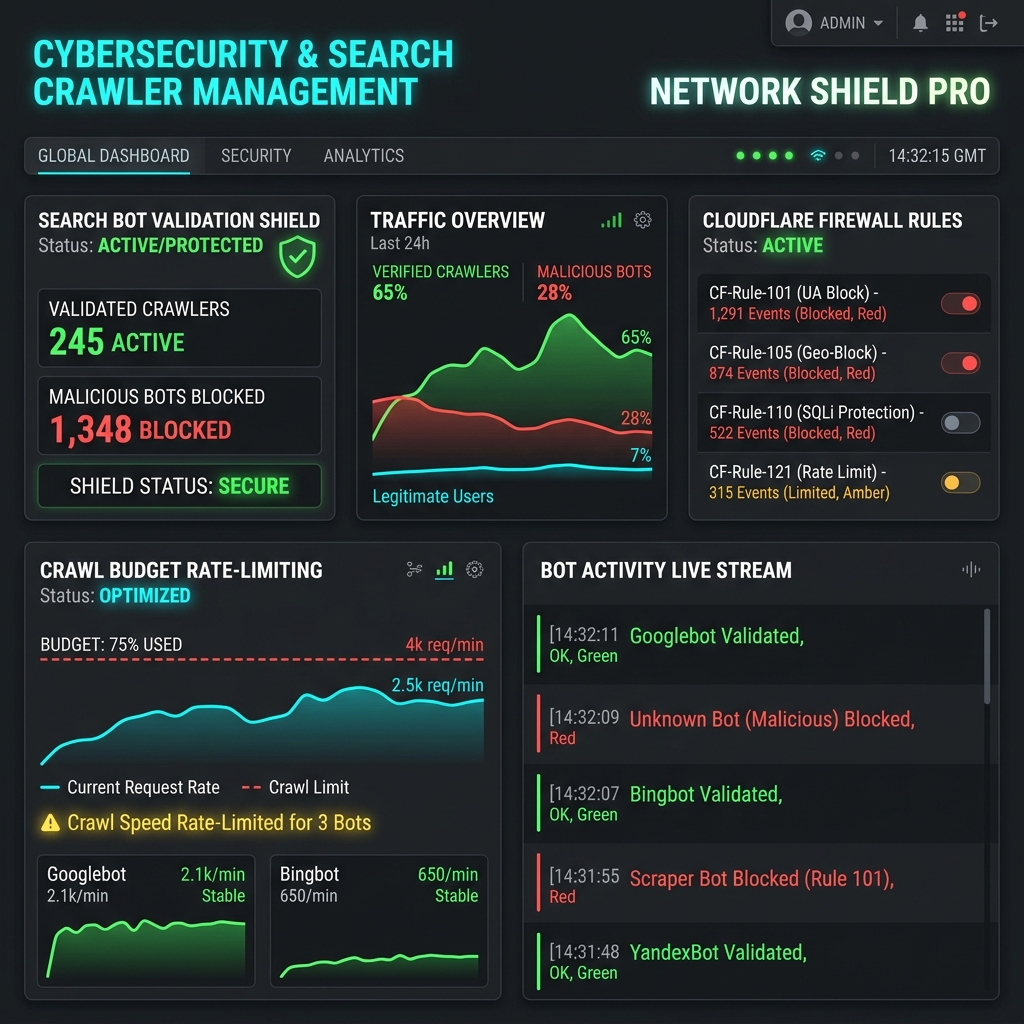
In the modern web landscape, artificial intelligence companies deploy automated crawlers to harvest massive datasets for Large Language Model (LLM) training and real-time Retrieval-Augmented Generation (RAG). While traditional search crawlers like Googlebot and Bingbot index web pages to send referral traffic back to publishers, AI scrapers often digest content to display direct answers—frequently bypassing publisher visits altogether.
To maintain control over intellectual property, bandwidth costs, and server resources without sacrificing search engine visibility, technical SEOs and site administrators must implement a multi-layered defense strategy. This guide explores precise robots.txt directives, HTTP response header controls (X-Robots-Tag), CDN-level WAF rules, and Next.js Edge Middleware patterns.
Understanding AI Crawler Taxonomies & User-Agents
Not all AI bots perform the same function. AI crawlers fall into two distinct operational categories:
- Offline Training Crawlers: Background bots that crawl billions of pages to train future foundational models (e.g., GPT-5, Claude 3.5 Sonnet).
- Real-Time Retrieval Crawlers: Bots invoked on-demand when a user asks an AI search engine (e.g., ChatGPT Search, Perplexity) to summarize a live web page.
Comprehensive AI Crawler User-Agent Reference Matrix
| Bot Name | User-Agent Identifier | Operator | Primary Function | Business Impact | Recommended Policy |
|---|---|---|---|---|---|
| GPTBot | GPTBot | OpenAI | Offline LLM Pre-Training | Content ingestion for model weights | Disallow if opting out of training |
| ChatGPT-User | ChatGPT-User | OpenAI | Live User Web Search | Generates direct user referral traffic | Allow for referral visibility |
| ClaudeBot | ClaudeBot | Anthropic | Model Training & Data Scraping | Content ingestion without traffic | Disallow if opting out of training |
| Claude-Web | Claude-Web | Anthropic | Live Claude Web Retrieval | Answers user queries in real-time | Allow for live retrieval |
| PerplexityBot | PerplexityBot | Perplexity | Indexing & RAG Retrieval | Powers Perplexity AI citations | Allow for answer engine traffic |
| Bytespider | Bytespider | ByteDance | AI Data Scraping | High-frequency server resource load | Disallow & block at edge firewall |
| CCBot | CCBot | Common Crawl | Open-Source Training Datasets | Used by numerous AI startups | Disallow for non-public assets |
| Meta-ExternalAgent | Meta-ExternalAgent | Meta | Llama Model Training | Ingests public web data | Disallow if preserving copyright |
Production-Grade robots.txt Configuration
A well-structured robots.txt file acts as the first line of defense. By targeting specific User-Agent strings, you can grant access to search engines while restricting AI scrapers.
User-Agent: Googlebot
Allow: /

User-Agent: Bingbot
Allow: /

User-Agent: DuckDuckBot
Allow: /

User-Agent: YandexBot
Allow: /

User-Agent: GPTBot
Disallow: /

User-Agent: ChatGPT-User
Allow: /

User-Agent: ClaudeBot
Disallow: /

User-Agent: Claude-Web
Allow: /blog/
Allow: /docs/
Disallow: /api/
Disallow: /private/
Crawl-delay: 2

User-Agent: PerplexityBot
Allow: /
Disallow: /account/
Disallow: /checkout/

User-Agent: CCBot
Disallow: /

User-Agent: Bytespider
Disallow: /

User-Agent: Meta-ExternalAgent
Disallow: /

User-Agent: Diffbot
Disallow: /

Sitemap: https://www.seotech.app/sitemap.xml
Advanced Edge Middleware & HTTP Header Enforcement
Because robots.txt is an advisory standard that non-compliant crawlers may bypass, modern web applications enforce bot management at the application layer or CDN edge.
HTTP Response Headers (X-Robots-Tag)
The X-Robots-Tag header provides explicit metadata instructions to crawlers processing non-HTML files (like PDF downloads, JSON endpoints, or images):
HTTP/1.1 200 OK
Content-Type: application/json
X-Robots-Tag: noindex, noarchive, noai, noimageai
Next.js Edge Middleware Bot Guard
Below is a production Next.js Edge Middleware script that inspects incoming user agents, enforces HTTP 403 blocks for unauthorized scrapers, and injects protective security headers.
import { type NextRequest, NextResponse } from 'next/server'

// Targeted AI Scraper User-Agent Signatures
const BLOCKED_AI_SCRAPERS = [
  'GPTBot',
  'ClaudeBot',
  'CCBot',
  'Bytespider',
  'Meta-ExternalAgent',
  'Diffbot',
  'Cohere-ai',
  'Omgilibot',
]

// Real-Time Search Crawlers Allowed for Live Citations
const ALLOWED_RETRIEVAL_BOTS = ['ChatGPT-User', 'PerplexityBot', 'Claude-Web']

export function middleware(request: NextRequest) {
  const userAgent = request.headers.get('user-agent') || ''
  const pathname = request.nextUrl.pathname

  // Allow static assets and Next.js internal files immediately
  if (
    pathname.startsWith('/_next') ||
    pathname.startsWith('/favicon.ico') ||
    pathname.match(/\.(png|jpg|jpeg|svg|webp|css|js)$/)
  ) {
    return NextResponse.next()
  }

  // Check if request comes from an allowed real-time retrieval bot
  const isAllowedRetrieval = ALLOWED_RETRIEVAL_BOTS.some((bot) =>
    userAgent.toLowerCase().includes(bot.toLowerCase())
  )

  if (isAllowedRetrieval) {
    const response = NextResponse.next()
    response.headers.set('X-AI-Retrieval-Status', 'Allowed-Live-Search')
    return response
  }

  // Check for unauthorized AI training bots
  const isBlockedScraper = BLOCKED_AI_SCRAPERS.some((bot) =>
    userAgent.toLowerCase().includes(bot.toLowerCase())
  )

  if (isBlockedScraper) {
    return new NextResponse(
      JSON.stringify({
        error: 'Forbidden',
        message: 'AI model training scrapers are restricted on this domain.',
        documentation: 'https://www.seotech.app/blog/ai-search-bot-indexing-control',
      }),
      {
        status: 403,
        headers: {
          'Content-Type': 'application/json',
          'X-Robots-Tag': 'noindex, noarchive, noai',
        },
      }
    )
  }

  // Standard response with default AI protection headers
  const response = NextResponse.next()
  response.headers.set('X-Robots-Tag', 'noai, noimageai')
  return response
}

export const config = {
  matcher: '/((?!api/health).*)',
}
Cloudflare WAF & Edge Firewall Configuration
For enterprise applications experiencing heavy crawler traffic, filtering requests at the application layer (Node.js/Next.js) can incur unnecessary compute costs. Configuring Cloudflare Web Application Firewall (WAF) rules offloads bot blocking directly to the CDN edge.
Recommended Cloudflare Expression Rule
(http.user_agent contains "GPTBot" and not http.user_agent contains "ChatGPT-User") or
(http.user_agent contains "ClaudeBot") or
(http.user_agent contains "Bytespider") or
(http.user_agent contains "CCBot")Action: Block or Managed Challenge
Key Execution & Audit Checklist
- Audit Case-Sensitive User Agents: Confirm that
robots.txtstrings match exact official bot definitions (GPTBot,ClaudeBot). - Separate Training Bots from Retrieval Bots: Ensure
ChatGPT-UserandPerplexityBotare allowed if real-time AI citation traffic is desired. - Deploy X-Robots-Tag Headers: Inject
X-Robots-Tag: noai, noimageaiacross static file distributions and API routes. - Verify Googlebot Indexability: Run Google Search Console URL Inspection to verify Googlebot is unaffected by AI bot rules.
- Monitor Server Compute Metrics: Track CPU and memory spikes to confirm that edge WAF rules successfully deflect brute-force scrapers.
Conclusion
Controlling AI crawlers requires a nuanced approach: blocking aggressive training bots while keeping channels open for referral-generating AI search engines. By combining strict robots.txt rules with CDN-level WAF filtering and X-Robots-Tag response headers, engineering teams can safeguard content assets without sacrificing organic search authority.
Official References
Frequently Asked Questions
Does blocking GPTBot impact Google search rankings?
No, blocking GPTBot or ClaudeBot via robots.txt only prevents those specific AI crawlers from scraping your content for model training. It does not affect Googlebot, Bingbot, or your Google search indexation.
What is the technical difference between GPTBot and ChatGPT-User?
GPTBot is OpenAI's automated background crawler used to collect datasets for offline LLM pre-training. ChatGPT-User is triggered in real-time when an active user prompts ChatGPT to browse a specific web URL.
How can I block AI bots at the CDN / Edge level?
You can inspect the incoming User-Agent header and ASN IP ranges in Cloudflare WAF, Vercel Middleware, or AWS CloudFront, returning a 403 Forbidden or 429 Too Many Requests response for unauthorized AI agents.
What is the X-Robots-Tag noai header?
The X-Robots-Tag HTTP header delivers crawling and indexing directives directly in HTTP response headers. Setting X-Robots-Tag: noai signals to compliant web scrapers that content must not be used for machine learning models.
Will blocking AI crawlers affect my inclusion in AI search answers?
If you block live retrieval bots like PerplexityBot or ChatGPT-User, your site will not be cited in real-time AI search answers. However, blocking offline training bots like GPTBot or CCBot will not prevent live retrieval citations if retrieval bots remain allowed.
Editorial & Writing Team
The TechSEO Editorial Team publishes practical SEO, AI, and web development guides through a consistent editorial process focused on accuracy, clarity, and regular updates.
Subscribe to TechSEO Insights
Get the latest guides on technical SEO, Core Web Vitals, and content marketing delivered straight to your inbox.
Privacy Note: By subscribing, you agree to receive our newsletter (Lawful Basis: Consent). We retain your email address until you choose to unsubscribe. For more details, view our Privacy Policy.