Google AI Overviews & GEO: How to Rank in Generative Search Answers
Master Generative Engine Optimization (GEO) to optimize content for Google AI Overviews, LLM citations, direct answer blocks, and entity-driven search responses.

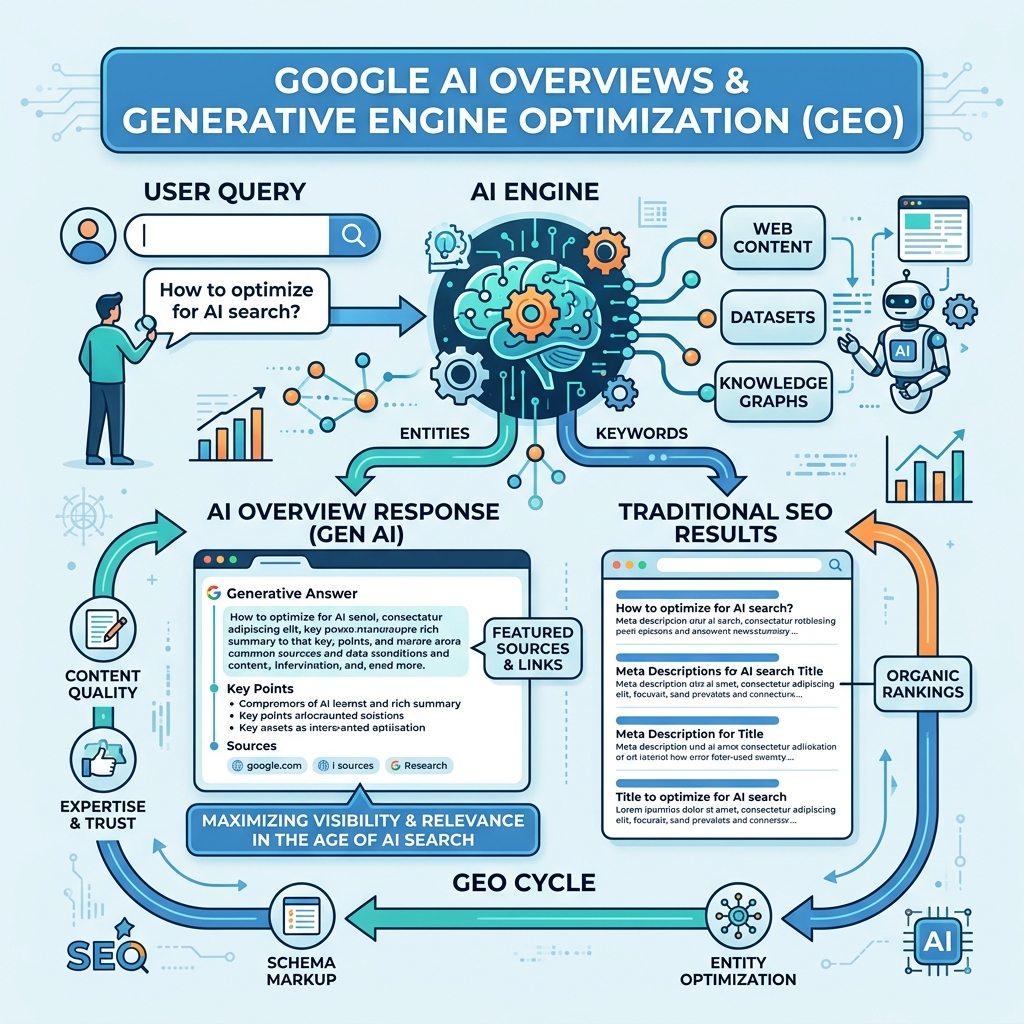
Key Takeaways
- Generative Engine Optimization (GEO) shifts focus from keyword density to information density, entity relationships, statistical citations, and authoritative source grounding.
- Structure content using concise direct summary paragraphs (40-60 words) positioned immediately beneath explicit H2 and H3 headings to facilitate Retrieval-Augmented Generation (RAG).
- Implement deeply nested JSON-LD schema containing speakable, definedTerm, and itemReviewed properties to align with Google Knowledge Graph entities.
- Combine traditional Core Web Vitals optimization with high factual precision to ensure RAG crawlers fetch and synthesize your page content in real-time AI Overviews.
Executive Overview: The Rise of Generative Engine Optimization (GEO)
Search engine technology has undergone a fundamental architectural shift. With the deployment of Google AI Overviews (powered by Google Gemini models) and AI-first answer engines like Perplexity and ChatGPT Search, user search queries are increasingly answered directly at the top of the search engine results page (SERP).
Rather than displaying ten traditional blue links, AI Overviews construct multi-paragraph synthesized answers supported by interactive link cards. To remain visible in this new paradigm, digital marketing and engineering teams must master Generative Engine Optimization (GEO)—a disciplined framework designed to maximize content inclusion, semantic entity recognition, and source citation within AI-generated responses.
Technical Comparison: Traditional SEO vs Generative Engine Optimization (GEO)
Understanding how GEO differs from traditional search optimization is vital for prioritizing editorial and technical investments.
| Strategy Dimension | Traditional Search Engine Optimization (SEO) | Generative Engine Optimization (GEO) |
|---|---|---|
| Primary SERP Objective | Rank in position #1-#3 of organic blue links | Earn prominent link card citations inside AI Overviews |
| Indexing Mechanism | Static HTML indexing & link graph analysis | Retrieval-Augmented Generation (RAG) chunking |
| Target Content Unit | Comprehensive long-form articles | Modular, high-density factual blocks & direct answers |
| Key Optimization Metric | Keyword placement, search volume & CTR | Factual precision, entity clarity & quote frequency |
| Structured Data Priority | Basic Article / WebPage JSON-LD | Deeply nested Entity, Speakable & DefinedTerm Schema |
| Formatting Strategy | Narrative introduction & engagement hooks | Direct 40-60 word answer summaries under clear H2s |
Key Signals Influencing Google AI Overview Citations
Academic research on Generative Engine Optimization (including landmark studies from Princeton, Georgia Tech, and Allen Institute for AI) reveals specific content characteristics that significantly increase an article's citation likelihood in LLM responses:
- Information Density: Pages with concise, stat-rich sentences outperform fluff-heavy long-form text.
- Authoritative Citation: Including direct quotes, technical standards, and empirical data points increases trust scores in RAG rankers.
- Structured Comparison Tables: Markdown and HTML tables providing side-by-side data allow LLMs to quickly extract tabular knowledge.
- Entity Grounding: Explicitly naming concepts, standards, and organizations matching Google's Knowledge Graph simplifies semantic matching.
Technical GEO Implementation & JSON-LD Entity Schema
To enable Google's Gemini models to parse entity relationships without ambiguity, embed rich JSON-LD schema utilizing speakable, definedTerm, and mainEntity declarations.
{
  "@context": "https://schema.org",
  "@graph": [
    {
      "@type": "TechArticle",
      "@id": "https://www.seotech.app/blog/google-ai-overviews-geo-optimization#article",
      "headline": "Google AI Overviews & GEO: How to Rank in Generative Search Answers",
      "description": "Comprehensive guide to Generative Engine Optimization (GEO) for AI search engine placement.",
      "inLanguage": "en-US",
      "mainEntityOfPage": "https://www.seotech.app/blog/google-ai-overviews-geo-optimization",
      "datePublished": "2026-07-22T08:00:00Z",
      "dateModified": "2026-07-22T08:00:00Z",
      "author": {
        "@type": "Organization",
        "name": "TechSEO Editorial Team",
        "url": "https://www.seotech.app/about"
      },
      "publisher": {
        "@type": "Organization",
        "name": "TechSEO App",
        "logo": {
          "@type": "ImageObject",
          "url": "https://www.seotech.app/logo.png"
        }
      },
      "speakable": {
        "@type": "SpeakableSpecification",
        "cssSelector": [".geo-executive-summary", ".key-takeaways"]
      },
      "about": [
        {
          "@type": "DefinedTerm",
          "name": "Generative Engine Optimization",
          "termCode": "GEO",
          "description": "Methodology for optimizing digital content to feature in AI-generated search summaries."
        },
        {
          "@type": "Thing",
          "name": "Google AI Overviews",
          "sameAs": "https://en.wikipedia.org/wiki/Google_Search"
        }
      ]
    }
  ]
}
Content Chunking & RAG Summary Extraction Utility
RAG systems slice web pages into semantic text chunks (typically 200–500 tokens). To optimize your content for chunk retrieval, structure every major section with a clear H2 heading, followed immediately by a self-contained 50-word answer block.
Here is a TypeScript utility for rendering AI Overview-friendly content chunks in Next.js applications:
export interface GEOChunkProps {
  sectionTitle: string
  entityName: string
  directSummary: string // 40-60 words ideal for RAG extraction
  bulletPoints: string[]
  codeSnippet?: string
}

export function GEOContentChunk({
  sectionTitle,
  entityName,
  directSummary,
  bulletPoints,
  codeSnippet,
}: GEOChunkProps) {
  return (
    <div
      className="geo-chunk my-8 rounded-lg border border-slate-200 p-6 bg-slate-50"
      data-entity={entityName}
    >
      <h2 className="text-2xl font-bold text-slate-900 mb-3">{sectionTitle}</h2>

      {/* Executive Direct Answer Summary for RAG Scrapers */}
      <p className="geo-executive-summary text-base leading-relaxed text-slate-800 font-medium mb-4">
        {directSummary}
      </p>

      {/* Structured Key Points */}
      <ul className="key-takeaways list-disc pl-6 space-y-2 text-slate-700">
        {bulletPoints.map((point, index) => (
          <li key={index}>{point}</li>
        ))}
      </ul>

      {/* Code or Data Demonstration */}
      {codeSnippet && (
        <pre className="mt-4 overflow-x-auto rounded bg-slate-900 p-4 text-sm text-slate-100">
          <code>{codeSnippet}</code>
        </pre>
      )}
    </div>
  )
}
Actionable GEO Execution Checklist
- Place 40-60 Word Direct Answers First: Position succinct summaries immediately below H2/H3 headings.
- Incorporate Verified Data Points & Benchmarks: Include statistics, technical metrics, and original research.
- Implement Tabular Data Comparisons: Use Markdown tables for side-by-side technical specifications.
- Add Speakable & DefinedTerm Schema: Annotate key definitions and summary blocks with JSON-LD metadata.
- Maintain Core Web Vitals Excellence: Fast LCP (<2.5s) and low TTFB (<0.8s) are critical for real-time RAG crawlers.
Conclusion
As search engines shift from returning blue links to generating direct answers, mastering Generative Engine Optimization is essential for securing digital brand visibility. By combining technical JSON-LD entity grounding with structured, factual content chunking, web publishers can earn persistent citations across Google AI Overviews and next-generation answer engines.
Official References
Frequently Asked Questions
What is Generative Engine Optimization (GEO)?
Generative Engine Optimization (GEO) is the technical and content practice of optimizing web pages to be selected, cited, and summarized by LLM-driven search engines like Google AI Overviews, ChatGPT Search, and Perplexity AI.
How does Google AI Overviews select source links?
Google AI Overviews uses Retrieval-Augmented Generation (RAG) to query traditional organic search indexes, fetch top-ranking pages with high factual density and clear entity structures, and synthesize concise synthesized answers with embedded link cards.
Does traditional SEO still matter for Google AI Overviews?
Yes. Traditional ranking factors like Core Web Vitals, domain authority, indexability, and backlink signals remain essential prerequisites because RAG systems retrieve content primarily from top organic ranking pages.
What content formats perform best in Google AI Overviews?
Bullet point lists, comparative benchmark tables, direct 50-word definition blocks, and verified statistical citations consistently achieve higher inclusion rates in AI Overview snapshots.
How can I measure traffic coming from Google AI Overviews?
In Google Search Console, AI Overview performance is currently reported within standard web search performance reports. You can track organic traffic spikes on queries displaying AI Overviews alongside referral parameters.
Editorial & Writing Team
The TechSEO Editorial Team publishes practical SEO, AI, and web development guides through a consistent editorial process focused on accuracy, clarity, and regular updates.
Subscribe to TechSEO Insights
Get the latest guides on technical SEO, Core Web Vitals, and content marketing delivered straight to your inbox.
Privacy Note: By subscribing, you agree to receive our newsletter (Lawful Basis: Consent). We retain your email address until you choose to unsubscribe. For more details, view our Privacy Policy.