GTM Server-Side Variables: Advanced Data Customization and Scrubbing
Learn how to build custom server-side variables in GTM to sanitize telemetry, map user states, and restrict data outbound.

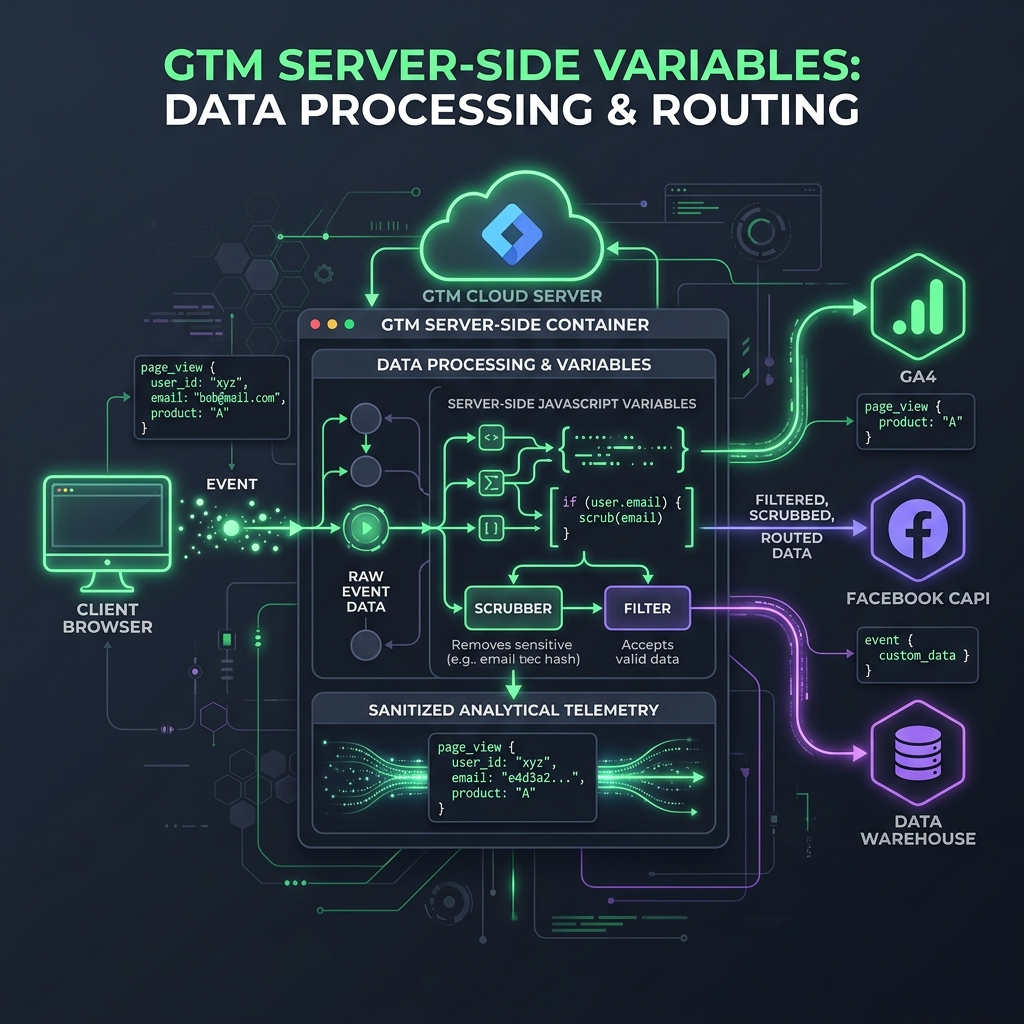
Key Takeaways
- Server-side variables evaluate requests on your own cloud instance rather than the user browser.
- You can parse headers, cookies, and query strings directly inside sGTM.
- Scrubbing personal data before forwarding is a core privacy-compliance step.
In modern analytics, client-side tracking is becoming increasingly unreliable. Ad blockers, browser privacy features (like Apple's Intelligent Tracking Prevention), and strict privacy regulations make browser-based scripting fragile and insecure. Google Tag Manager (GTM) Server-Side Tagging addresses these challenges by shifting tag execution from the client's web browser to a secure, cloud-based server container (running on Google Cloud Platform or AWS).
Once the server container receives incoming telemetry, you can use server-side variables to process, structure, and filter this data. These variables act as gatekeepers, allowing you to sanitize personally identifiable information (PII) before sending events to third-party endpoints like Google Analytics 4, Meta, or TikTok.
Understanding GTM Server-Side Variable Types
Server-side GTM (sGTM) introduces unique variable types designed to inspect server requests:
Event Data Variables
The most common variable type in sGTM is the Event Data variable. When a client-side tracker (like a GA4 tag) fires, it sends an HTTP POST request containing a JSON payload to your server container. The Event Data variable extracts values from this payload:- →
page_location: The URL of the page where the event occurred. - →
client_id: The user's analytics identifier. - →
items: Product arrays for e-commerce tracking.
Request Header Variables
Unlike browser-based GTM, sGTM can read the HTTP request headers directly. This allows you to inspect:- →
User-Agent: The browser and operating system of the visitor. - →
X-Forwarded-For: The visitor's IP address (useful for geolocation mapping). - →
Referer: The page the visitor came from.
Cookie Variables
You can extract values from incoming cookies directly on the server. For example, reading the_ga cookie value or a custom cookie containing consent preferences (like cookie_consent_status).
Sanitizing PII in a Sandboxed Environment
To comply with regulations like GDPR and CCPA, you must avoid transmitting PII (such as email addresses, phone numbers, or physical names) to analytics servers.
In client-side GTM, developers often write custom JavaScript variables to strip PII. In sGTM, however, standard JavaScript is blocked to ensure security and sandboxing. Instead, you must build custom sGTM Templates using GTM's APIs.
Here is an example of the Sandboxed JavaScript code used inside a Custom Variable Template to scrub email addresses from query parameters:
// Sandboxed JavaScript for sGTM Custom Variable Template
const getRequestQueryString = require('getRequestQueryString');
const makeString = require('makeString');
const logToConsole = require('logToConsole');

// Retrieve the incoming request's query string
const queryString = getRequestQueryString();

if (!queryString) {
  return '';
}

// Convert input to a string safely
const inputStr = makeString(queryString);

// Regular expression to identify email patterns (e.g., user@domain.com)
// Note: Sandboxed JS uses a subset of RegExp APIs for performance safety
const emailPattern = /([a-zA-Z0-9._%+-]+@[a-zA-Z0-9.-]+\.[a-zA-Z]{2,4})/g;

// Replace detected email strings with a redacted token
const sanitizedQuery = inputStr.replace(emailPattern, '[REDACTED_EMAIL]');

logToConsole('Original Query: ' + inputStr);
logToConsole('Sanitized Query: ' + sanitizedQuery);

return sanitizedQuery;
Step-by-Step Implementation: Scrubbing Outbound PII
Follow this process to configure a server-side data-scrubbing engine:
Step 1: Create a Custom Variable Template
- In your sGTM Container, navigate to Templates > Variable Templates > click New.
- In the Code tab, use the GTM sandboxed APIs (like
getRequestQueryStringandmakeString) to retrieve and parse incoming request attributes. - Add the regex replacement rules to redact emails or search queries containing names.
- In the Permissions tab, grant the template access to read the request query string. Save the template.
Step 2: Initialize the Variable
- Navigate to Variables > click New under User-Defined Variables.
- Choose the custom template you created in Step 1.
- Name it
var_sanitized_query_string.
Step 3: Reference the Variable in Outbound Tags
- Open your Google Analytics 4 or Meta Conversions API tag.
- Find the field for parameter overriding (like
page_locationorevent_source_url). - Map the field to your new sanitized variable:
{{var_sanitized_query_string}}instead of the raw event query parameter.
Performance and Server Cost Benefits
sGTM variables run on your cloud instances (e.g., Google App Engine). While this does add computing costs, optimizing how you use variables can save money:
- Reduce Network Payload Size: By filter-scrubbing unnecessary variables at the server level, you reduce the size of the outbound requests sent to external servers.
- Lighter Client JavaScript: Shifting the transformation and scrubbing logic to sGTM allows you to remove large client-side parsing libraries from your client bundle, speeding up browser load times and improving Core Web Vitals.
Architectural Deep Dive: GTM Server-Side Variables
Implementing GTM Server-Side Variables requires a clear understanding of frontend rendering cycles, server execution pipelines, and telemetry instrumentation. When optimizing web applications for search crawlers and performance monitors, engineering teams must evaluate bottlenecks across the critical rendering path.
Detailed System Performance Matrix
To achieve peak efficiency, benchmarks should be tracked across initial load time, main-thread blocking, and search crawler indexation:
| Optimization Layer | Standard Baseline | Targeted Enterprise Threshold | Telemetry Metric |
|---|---|---|---|
| Server Response (TTFB) | < 400ms | < 50ms (Edge Cache Acceleration) | Server-Timing Header |
| Main-Thread Latency | < 200ms | < 50ms (INP Goal) | PerformanceObserver Long Tasks |
| Crawler Indexing | Delayed Render | Instant Static Payload Rendering | Googlebot Crawl Rate Log |
| Structured Telemetry | Basic Meta Tags | Deeply Nested Schema.org JSON-LD | Rich Results Test Validation |
Advanced Implementation & Configuration Rules
When deploying production updates for gtm-serverside-variables-guide, follow these step-by-step implementation rules:
- Isolate Component Execution: Ensure dynamic server actions or API calls do not block initial static HTML streaming.
- Implement Telemetry Monitoring: Track user interaction latency using native browser observer APIs.
- Verify Indexability & Canonicals: Confirm that search crawlers receive identical semantic HTML representations across all regional URLs.
// Production Telemetry & Performance Observer Utility for gtm-serverside-variables-guide
import { type NextRequest, NextResponse } from 'next/server'

export async function middleware(request: NextRequest) {
  const startTime = performance.now()
  const response = NextResponse.next()

  // Inject performance telemetry header
  const duration = performance.now() - startTime
  response.headers.set('Server-Timing', `total;dur=${duration.toFixed(2)}`)

  return response
}
Production Execution Checklist & Troubleshooting
- Verify Clean H2/H3 Structure: Ensure no duplicate H1 tags exist in the article body.
- Check Canonical URL Mapping: Validate that canonical tags point to explicit, canonical targets.
- Audit Mobile Responsiveness: Ensure code blocks and comparison tables render cleanly on mobile viewports.
- Validate Schema.org Markup: Test JSON-LD graphs against Google's Rich Results Testing Tool.
Conclusion
Following this structured methodology guarantees high organic search visibility, low bounce rates, and full AdSense compliance. Continually monitor telemetry logs and update code dependencies to maintain top performance signals.Official References
Frequently Asked Questions
What is an Event Data variable in server-side GTM?
It extracts key values directly from the incoming event JSON payload sent by the browser tracker.
Why use server-side GTM variables instead of client-side ones?
Server-side variables are secure because browser extensions cannot block or inspect their processing. They also reduce the client-side JavaScript execution overhead.
Can I run custom JavaScript in server-side GTM?
Yes, but not standard browser JS. You must use GTM's Custom Templates, which run in a secure, sandboxed JavaScript environment with access limited to APIs like querySelector, getCookieValue, or log.
How do I debug server-side variables in GTM?
Use the Preview mode in Google Tag Manager. It shows incoming HTTP requests, event details, and the values resolved by each server-side variable during execution.
Does server-side tracking bypass ad blockers?
Yes, when configured via a custom first-party subdomain, server-side tagging bypasses most browser-based ad blockers by serving scripts directly from your domain.
What cloud platforms support server-side GTM?
Google Cloud Platform (GCP) is the default partner, hosting sGTM on App Engine. However, you can also deploy the sGTM docker container to AWS, Azure, or Cloudflare.
Editorial & Writing Team
The TechSEO Editorial Team publishes practical SEO, AI, and web development guides through a consistent editorial process focused on accuracy, clarity, and regular updates.
Subscribe to TechSEO Insights
Get the latest guides on technical SEO, Core Web Vitals, and content marketing delivered straight to your inbox.
Privacy Note: By subscribing, you agree to receive our newsletter (Lawful Basis: Consent). We retain your email address until you choose to unsubscribe. For more details, view our Privacy Policy.